Written: Late 2023 (inferred from the text)
Researching Player Freedom Through Risk–Reward Design
Risk preference, failure, gameplay loops, and checkpoints: an analysis of Dave the Diver and a Flappy Bird design thought experiment.
This is a complete, paragraph-aligned English translation of the author’s supplied Word manuscript, prepared for this website. Examples and product status reflect the time of writing. Original figures are retained, including text in their original language.
Contents
Researching Player Freedom Through Risk–Reward Design
Research purpose
Players increasingly demand freedom. They are less satisfied with extensions of cinematic, linear narrative experiences and want more participation: nonlinear stories, user-generated content, replayable PvP matches, personalized appearances, and more. Taking that demand as a starting point, I want to combine my previous understanding of risk–reward design with the idea of risk preference to explore possibilities for player freedom and offer potential design directions and references.
I have also noticed that increasingly difficult games receive widespread praise. Games once considered hardcore and niche—even by designers—are becoming more popular. Monster Hunter, Souls games, Tarkov, survival/open-world crafting games, and others are reaching beyond their core audiences. Why is difficulty, or the likelihood of failure, no longer necessarily negative in today's design context? What principles explain this? Beyond changing player preferences and perceptions, how can designers respond?
1. Discussing player freedom
Participation is games' greatest distinction from other media. Players feel control over their characters: where they move, how they fight, which attributes they upgrade. But they want more than designers' predetermined scripts, levels, and challenges. They want to explore freely, influence the stories of their characters and NPCs, and choose challenges at different difficulties.
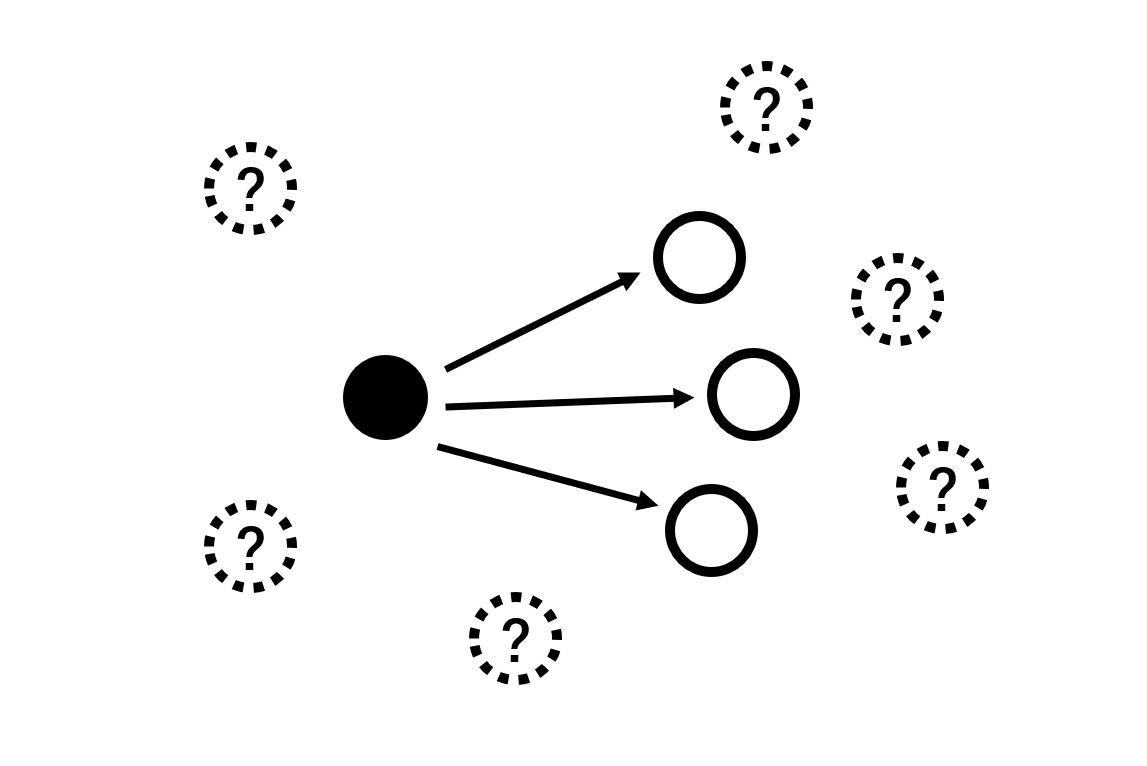
Compared with traditional Souls games, Elden Ring changes repeated self-improvement after hitting a wall into an open-world network of alternative exploration routes. The difficulty remains, but you can take another path through the world and return to a challenge when ready.
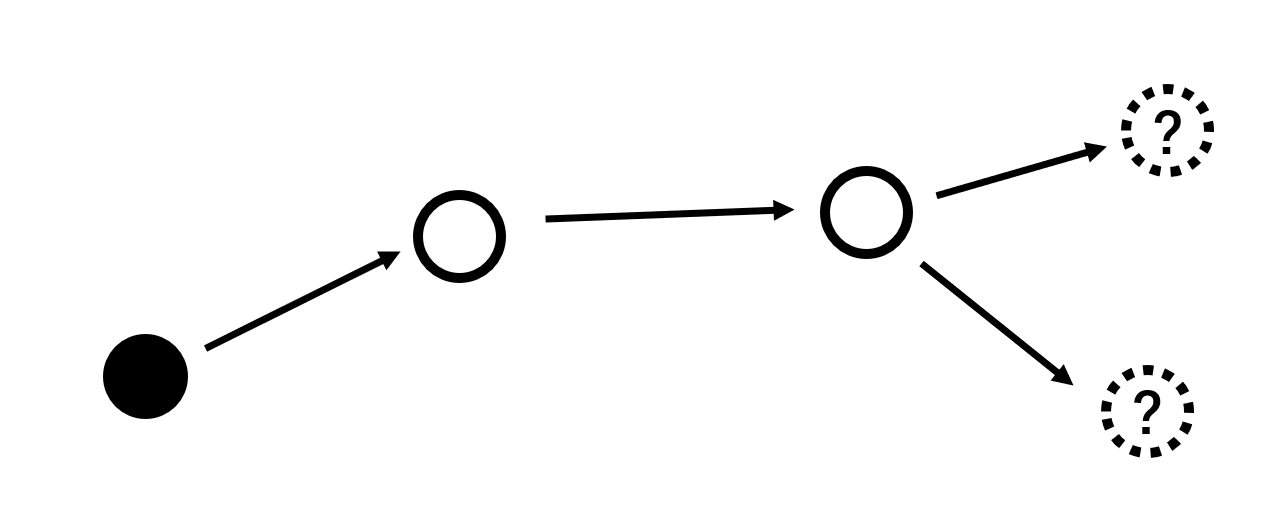
[Figure 1: Linear learning loops and open-world learning loops]
With a sufficiently powerful development team, designers could theoretically respond to countless player choices and actions at the content scale of Red Dead Redemption 2. Yet this is difficult to emulate because it exists only in theory. Development is always the art of using limited time and resources to create something players will spend more time playing.
There is much to discuss about expanding freedom: UGC and survival/open-world crafting games offer further possibilities. Those are not this article's focus. I want to examine, from the origin of a design, how risk and reward alone might change the freedom a game provides.
Freedom itself is an extremely broad concept: freedom of gameplay, story, pacing, difficulty, personal expression, and so on. Risk design cannot encompass all of it. This discussion primarily concerns mechanics.
Another negative buzzword I want to discuss is the Chinese expression for doing prison time in a game. You may hear it frequently in streams and player comments. Is that feeling the opposite of freedom?
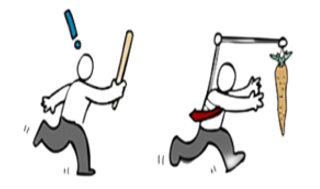
Its exact origin is unclear, but it generally describes repetitive activities that players feel compelled to do because the rewards are good. Many anime-style games feature such designs: dull daily tasks with rewards unavailable elsewhere. Addressing this at the design level means asking why players must endure monotonous experiences, and whether stronger intrinsic motivations could replace reward alone. In risk–reward terms, the core problem is low risk with high reward: players feel obliged to participate, but the experience is boring.
2. What are the ultimate challenges of gameplay-mechanic design?
1. Replayability
Many designers discuss replay value: using sophisticated mechanics to make a small amount of content support more play time. Often this is wishful thinking. Adding PvP, social interaction, or randomness does not automatically produce more content. Players need meaningful variation in their actions, challenges, and outcomes each time to feel the desire to play again.
2. Easy to learn, hard to master
Almost everyone wants to design a game with this quality. But how? Designers cite chess and Go, which certainly demonstrate it. The difficult question is how to construct such rules from scratch.
3. Emergent gameplay
Another familiar but elusive goal is emergence: game elements interact to produce new pleasures and possibilities beyond the individual gameplay opportunities deliberately supplied by their designers.
Everyone wants to solve these three longstanding problems. They sound wonderful, but are almost impossible to guarantee at the beginning of design. We recognize games that achieve them, yet struggle to create those qualities from nothing. Moreover, achieving one often helps solve the other two.
This article asks whether adding risk as a design dimension can bring us closer to these three goals.
3. Why make risk a central element of game design?
1. Risk management may offer a dimension beyond player skill
At a systems level, games usually challenge physical or intellectual abilities. Physical challenges concern reaction speed and dexterity; intellectual ones involve reasoning, strategy, and tactics. Limited inputs and outputs make it harder to challenge emotional intelligence, communication, or language abilities. Yet an implicit dimension involving personality appears in choices of class, gender, talents, and tools. In MMOs and other online games especially, character customization expresses a desired role personality. It need not match the real person, but it is something they want to play: a man might choose a female character, or a woman a powerful warrior. Could extending the challenge framework to risk give players further choices?
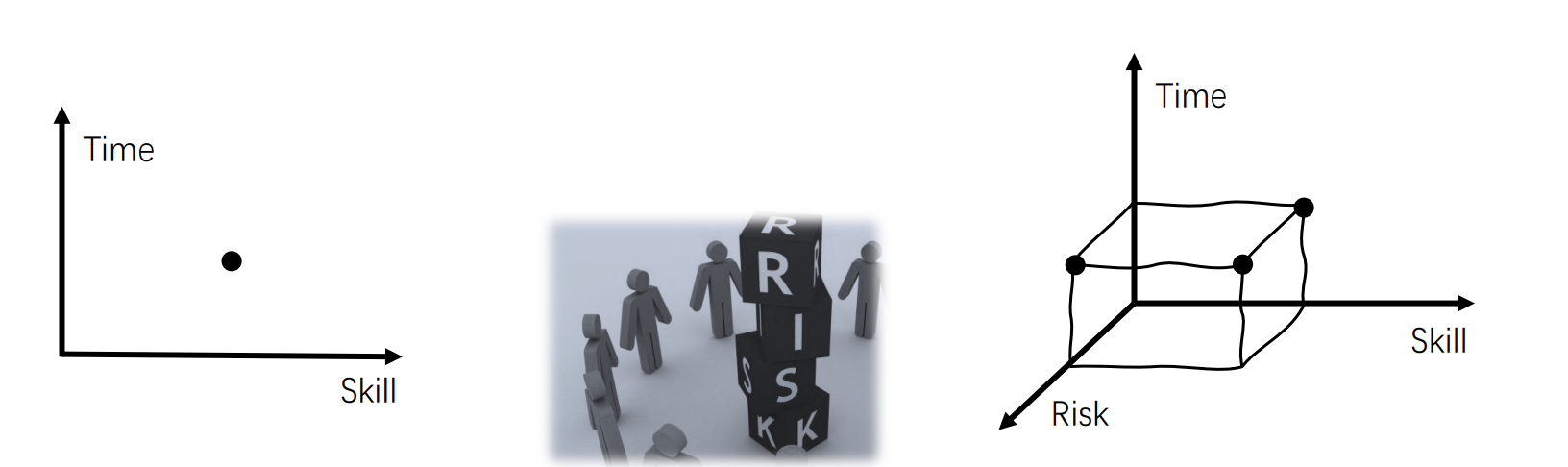
F2P player frameworks commonly segment people by time and skill. Money can often substitute for or compress time. Inspired by several games, I have begun considering risk as another dimension of player segmentation or challenge design; either application makes sense. A series of games prompted this perspective.
Battle royale's shrinking zone is a classic designer-controlled process for steadily increasing risk.
A defining feature of roguelikes is uncertainty about the next challenge. Although you become stronger, you cannot know whether the right capabilities will appear for what comes next. That uncertainty is a fundamental source of risk.
In Tarkov-like games, players can control their own match risk: spend heavily on the best armor, then scavenge in the safest part of the map. Maximum expenditure, minimum risk.
These games share a feature: within limits, players can manage risk. That control itself creates a feeling of freedom.
[Figure: Time, skill, and risk]
2. Risk–reward design is foundational to mechanics
When I began exploring this subject, I remembered Masahiro Sakurai's GDC 2004 talk on Risk and Return, which I heard early in my career. It left a strong impression. Interested readers can follow the link. Sakurai later opened a YouTube channel and revisited details of the theory:
https://archive.org/details/2004_GDC_-_03-24-2004_Sakurai_1230-130p_2-Channel
https://www.youtube.com/watch?v=FXqEykD5Ub4&t=16s
(Ah, 2004—and it is almost 2024. Nearly twenty years already!)
The theory asks designers to consider the risks and rewards of player actions whenever they design mechanics, offering comparable rewards for comparable risks. The Space Invaders example makes it particularly easy to understand.
The talk established for me how fundamental risk and reward are to mechanics. Their dynamic relationship is central to tuning balance and pacing. I will not repeat the full explanation here; Sakurai explains it very clearly.
[Figure: Masahiro Sakurai]
3. The peak–end rule gives high-risk games a better chance of winning players' hearts
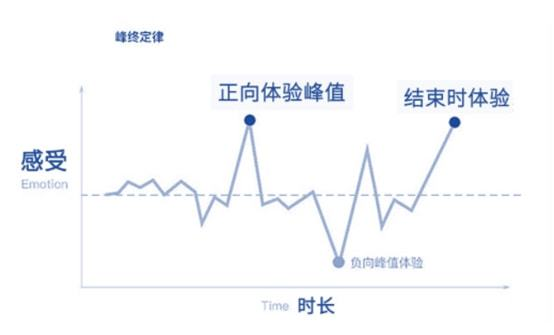
Many designers know the peak–end rule: after an experience, people primarily remember its peak and its ending, while the balance of good and bad moments and the overall duration have less influence on memory.
Designing the climax and ending therefore becomes essential. This article concerns mechanically driven experiences rather than narrative design, so storytelling climaxes and endings are outside its scope.
In mechanically driven games, climaxes often occur after accumulated learning, when everything depends on one decisive moment. It is Portal's nineteenth chamber requiring skills learned in the previous eighteen; the final blow after severing a Rathian's tail and breaking its head; a five-card Hearthstone combo taking an opponent from full health to defeat in one turn; or an alliance committing everything to a decisive strategy-game battle. Every player has such memories. Do they not often involve tingling nerves, sweaty palms, and high risk? Failure to secure victory at that moment may mean losing everything.
Truly memorable climaxes and peak–end moments are what make players sincerely feel that a game is fun.
4. The relationship between risk and designing failure
The problem of failure for new players
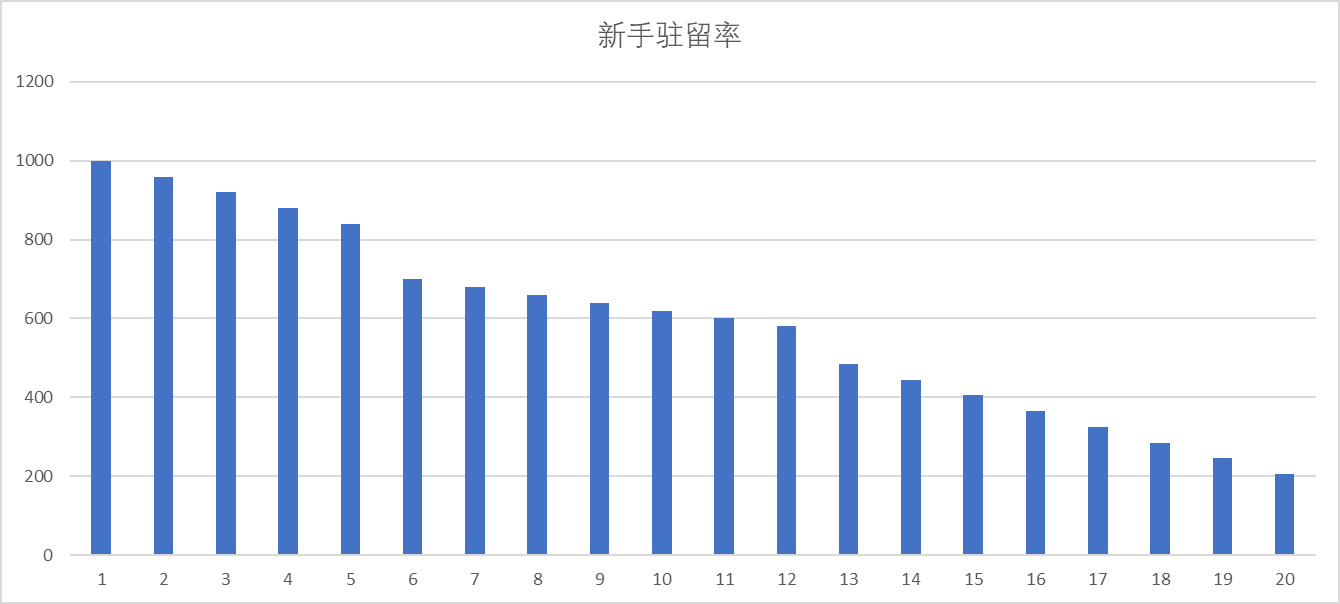
Virtual worlds differ from real life. The greatest risks games can offer concern failure and loss; lost progress, money, or time generally do not constitute very large real-world risks. Entertainment amplifies achievements unavailable in daily life: wealth through virtual currency, affection through fictional romance and friendship, authority through strategy and management, or power through combat. Traditional designers have often feared letting players fail, using detailed tutorials to explain mechanics and offering help and rewards after early setbacks. This was particularly evident in early F2P design, where the onboarding churn funnel became a common metric:

The figure shows a sharp drop between steps five and six. A difficult step causes failures and stops new players. Designers face a dilemma: lower difficulty and improve completion rates to smooth the curve, or move the necessary challenge later and provide more assistance first? Different designers and games have their own responses. Based solely on my development experience across several free games, these are my thoughts.
1. Failure is necessary, even if postponed. Learning from failure is fundamental to game enjoyment and cannot be replaced by another method.
2. A smooth churn curve should not be the design goal. Removing its kink does not necessarily solve the problem; revealing that kink is useful. Onboarding should identify the step at which players perceive the core enjoyment. Since every player is different, use clustering where possible to understand when different people discover that enjoyment.
3. Highly stimulating games, especially PvP and intense competitive games, can have a longer tolerance period before failure leads to churn, largely because their audiences expect to lose. Teaching and compensation after failure become especially important. In The Finals, a fast-paced shooter I have recently enjoyed, I did not finish first in my first ten matches and once lost the lead in the final five seconds, yet the experience remained excellent.
4. Games marketed as difficult, challenging, or hardcore already establish expectations of failure. Players may actively convert setbacks into learning instead of dwelling on frustration. Marketing and previous installments create this expectation for series such as Monster Hunter and Souls.
Do players resist risk and failure?
I recently read The Art of Failure, a book specifically about failing in games. Several of its ideas are worth mentioning.
1. Players who have failed rate games more highly
This is somewhat counterintuitive. Yet insufficient challenge can be boring, so appropriate failure can improve perceived enjoyment. Survivorship bias also matters: players who never experienced failure may already have left without finishing.

2. The paradox of failure also appears in its psychology: we tend to evade responsibility, yet improving our skills requires accepting our own mistakes. Advice on peak performance can therefore appear contradictory: games are played to win, but we should play to learn rather than simply to win. [Translated from the Chinese quotation in the original.]
Reality Is Broken repeatedly makes related points: much of games' learning value is established through learning from failure.
3. Skill, chance, and labor are three routes to victory in different kinds of games.
This differs slightly from the earlier skill–time–risk framework. Skill corresponds closely, and labor broadly corresponds to time, but chance is not identical to risk. Chance is better treated as a subset of risk, often concerning systemic uncertainty. Risk can also be subjective and player-controlled; managing it might itself be considered a subset of skill. The book's three-part classification remains reasonable when viewed as routes to victory.
My reflections on the book
1. Failure is more acceptable when players control it.
Win and loss conditions should allow greater flexibility, making the definition of failure crucial. Individuals have very different pressure thresholds. A single universal standard may therefore be unhelpful: what counts as a small, reliable pleasure or an unbearable catastrophe differs from player to player.
Letting players choose mission difficulty, rewards, duration, and competitiveness generally makes failure easier to accept. After all, they chose that path themselves.
2. Adaptive difficulty and risk
Older games sometimes adjusted difficulty automatically when players struggled—for instance, weakening a boss or, after repeated failures, suggesting that Easy mode would provide a better experience. This seems considerate, but many players experience it as an insult to their skill and intelligence. They could have learned through failure; instead, the system effectively tells them that they are below an average player standard.
From another angle, why do games such as Spider-Man 2 use heroic names for difficulty settings rather than simply Easy and Hard? Are designers protecting players' self-esteem?
Some F2P and service games use reassuring matches—against bots or through deliberately adjusted matchmaking—to maintain reasonable win rates and motivation to play again. Even when players recognized early, less subtle implementations, they often felt little hostility. The designers' kindness could genuinely feel comforting.
Resident Evil 4's dynamic difficulty is another relatively positive example. Many players never notice the hidden system, although those who discover it may exploit how it calculates difficulty. Capcom retained the concept in the recent remake.
Adaptive difficulty is therefore not inherently good or bad. Genre and the stage of play matter. Used well, it feels supportive; handled crudely, it insults the player. Designers must make that judgment.
3. Do not define victory too narrowly
Victory varies dramatically by genre. In a puzzle game such as Portal, finding the route to the next room may be enough. In a MOBA, repeatedly killing opponents is insufficient: you must push to their final defensive line and destroy their base—which sounds rather cruel when put that way!
Avoiding a simplistic definition can increase perceived freedom. Only one player or squad wins a battle royale, but each individual can improve relative to past performance: a higher placement or longer survival is another kind of victory. This does not necessarily weaken competition; it accommodates more kinds of players.
5. How to design risk in games
1. Designing risk through three gameplay loops
1. The three-loop framework
Divide play into second-to-second, minute-to-minute, and session-to-session loops. My earliest recollection of a related concept is the Halo designers' thirty seconds of fun.
Second to Second
Huge risks are usually unsuitable here because events occur frequently and often involve physical challenges: attack timing in action games, exchanges of fire in shooters, or ability rotations in MOBAs. Risk and reward should be frequent but relatively low to moderate.
A missed dodge in a combat loop might cost substantial HP without causing immediate failure. Poorly handled small, frequent risks instead accumulate into a significant later disadvantage.
Design keywords: high frequency, low-to-moderate risk and reward, accumulating advantages and disadvantages.
Minute to Minute
This often covers a complete level or match. Risk changes dynamically through several broad phases:
Starting phase
This connects with the beginning and end of the session-to-session loop: starting equipment, spawn location, party composition, and knowledge about the match. Good preparation can substantially reduce risk in the upcoming experience.
Accumulation phase
Several second-to-second loops combine, their accumulated results often determining the later climax—or leading directly to an ending without one. Positive and negative feedback loops commonly structure this phase. Call of Duty's killstreak rewards exemplify positive feedback, while Mario Kart's placement-dependent random items exemplify negative feedback; I will not expand on them here.
Climax phase
As discussed under peak–end experiences, this often contains the match's highest-stakes risk–reward decision.
Ending phase
The final phase distributes the minute-to-minute loop's rewards. Approaches vary: winner takes all, or some compensation for losers and early departures. The choice depends entirely on genre and design objectives.
Texas hold'em is, to me, a classic implementation of these four phases. Its rules and strategies are too complex to explain fully here, but studying them is highly useful when designing minute-to-minute loops.
Design keywords: starting conditions, accumulation loops, peak–end moments, reward distribution.
Session to Session
This is a larger cycle: a substantial RPG chapter or an entire MOBA season, composed of the outcomes and rewards of shorter loops. One example is the shift from Clash of Kings/war-game-style mobile strategy toward seasonal formats such as Infinite Borders and Three Kingdoms Tactics. The subject is too large to cover fully here. The central service-game problem is sustaining motivation and enjoyment across repeated seasons. One risk-design approach applies the four minute-to-minute phases to a whole season, balancing starting conditions and reward distribution between seasons.
Design keywords: seasonal boundaries, seasonal carryover.
2. Frequency and magnitude
Frequency means the interval between changes in risk; magnitude concerns the gap between high and low risk. High risk can create memorable peak–end experiences, but it also selects a narrower audience and attracts hardcore or niche labels. How can we find an appropriate frequency and range?
The answer is player segmentation, familiar to marketing and operations teams. Premium games should estimate their audience's tolerable range and frequency when choosing a theme and target market, matching that audience's rhythm. F2P games, with comparatively low barriers to acquiring a broad audience, can analyze behavior afterward to define segments more precisely. Risk tolerance, risk preference, and risk frequency can all inform data analysis.
2. Designing risk by dividing play into checkpoints and boundaries
This approach draws inspiration from save/load techniques and roguelikes. The three loops described above are not unbreakable structures. Many innovations arise from changing where play is divided: strategy-game seasons, or the connection between individual runs and persistent progression in Tarkov-like games, all design risk at such boundaries.
A brief explanation of save/load techniques
Here this means repeatedly reloading saved games and retrying to obtain an optimal solution or the most favorable outcome.
Especially in single-player games, save-point placement becomes essential to balancing risk. The space between save points defines a bounded stretch of exposure, effectively turning the interval into a minute-to-minute match.
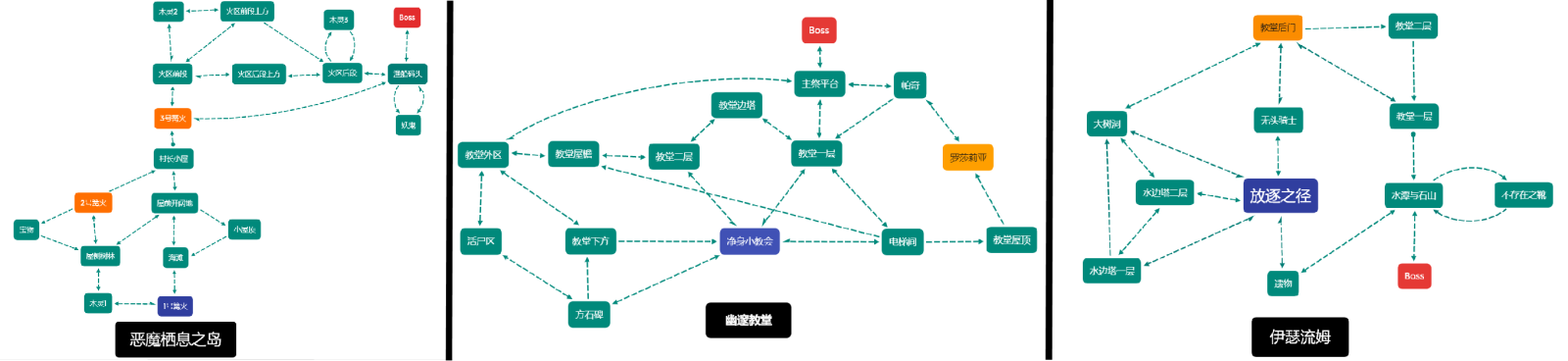
Bonfires in Souls games are crucial starting and ending points for risk. Their placement and the distances between them are important ways of dividing it.
The figure comes from a Zhihu essay analyzing Souls-like level topology:
How do you design a map that feels like Souls? On the topology of Souls-like levels — Zhihu
This is one example of how dividing play through risk can define an experience. Mobile and handheld games, designed to be picked up and put down at any moment, may need more frequent boundaries to suit short, frequent sessions.
These boundaries also require careful loss and failure design. A traditional checkpoint removes subsequent progress, but some games preserve money or items collected along the way, while others remove everything. This is closely tied to risk. Even in a heavily narrative-driven game such as Baldur's Gate 3, I suspect players frequently press F5 to protect their progress.
Dividing play means dividing players' risk. A long stretch without saving establishes an expectation about the journey. Whatever the outcome, creating that expectation is the first step toward a higher-risk experience. The crucial question is where designers place boundaries, because that directly affects perceived freedom.
Different genres need different approaches. The following keywords offer dimensions for evaluating the boundaries in your own game.
Design keywords: death penalties, permanent loss, persistent attributes, replay rewards, variety of completion methods.
3. Designing risk and reward through probability
I initially wanted to avoid this subject because probability leads inevitably to gambling, a term almost taboo in today's game design discourse. Yet discussing risk without it would barely scratch the surface.
To investigate, I consulted material including Addiction by Design, which examines Las Vegas casinos and slot-machine design. Several ideas in the book can be illuminating when related to games:
1. Mechanisms of addiction
The book draws on extensive gambling-addiction research and interviews. At a fundamental level, there are substantial similarities with game addiction.
“From all the research I have seen, what they [people addicted to gambling] really want is to forget and lose themselves in play.” [Translated from the Chinese quotation in the original.]
They suspend concerns about money, time, choice, and social life as they become absorbed. Physiology, personality, finances, and education affect addiction differently, and the research is complex. The point here is that probability-related absorption resembles the flow state many games seek. In this academic discussion, I am describing the method's effectiveness rather than judging it positively or negatively.
For a designer, this concerns what motivates continued play: fascination with the next uncertain outcome, recognition of desirable in-game value, and willingness to take greater risks.
For example, pachinko's kakuhen, or probability variation, can change the chance of winning after a payout—from 1/399 to 1/39, for instance—making another win more likely.
Jitan, or time shortening, reduces presentation time and provides assistance so players receive more drawing opportunities, more quickly.
Both are designed to keep winners playing rather than leaving, encouraging continued attachment.
2. Minimizing the experience of failure
Dim lighting, narrow spaces, low ceilings, and slot-machine placement in casino layouts encourage absorption. Money put into machines is experienced as part of play rather than calculated directly as a financial loss. This resembles techniques discussed earlier in relation to failure.
In game-design terms, players become accustomed to loss aversion and failure while retaining the courage to try again. Objective losses of time and money may be large, but subjectively people feel they can recover them next time.
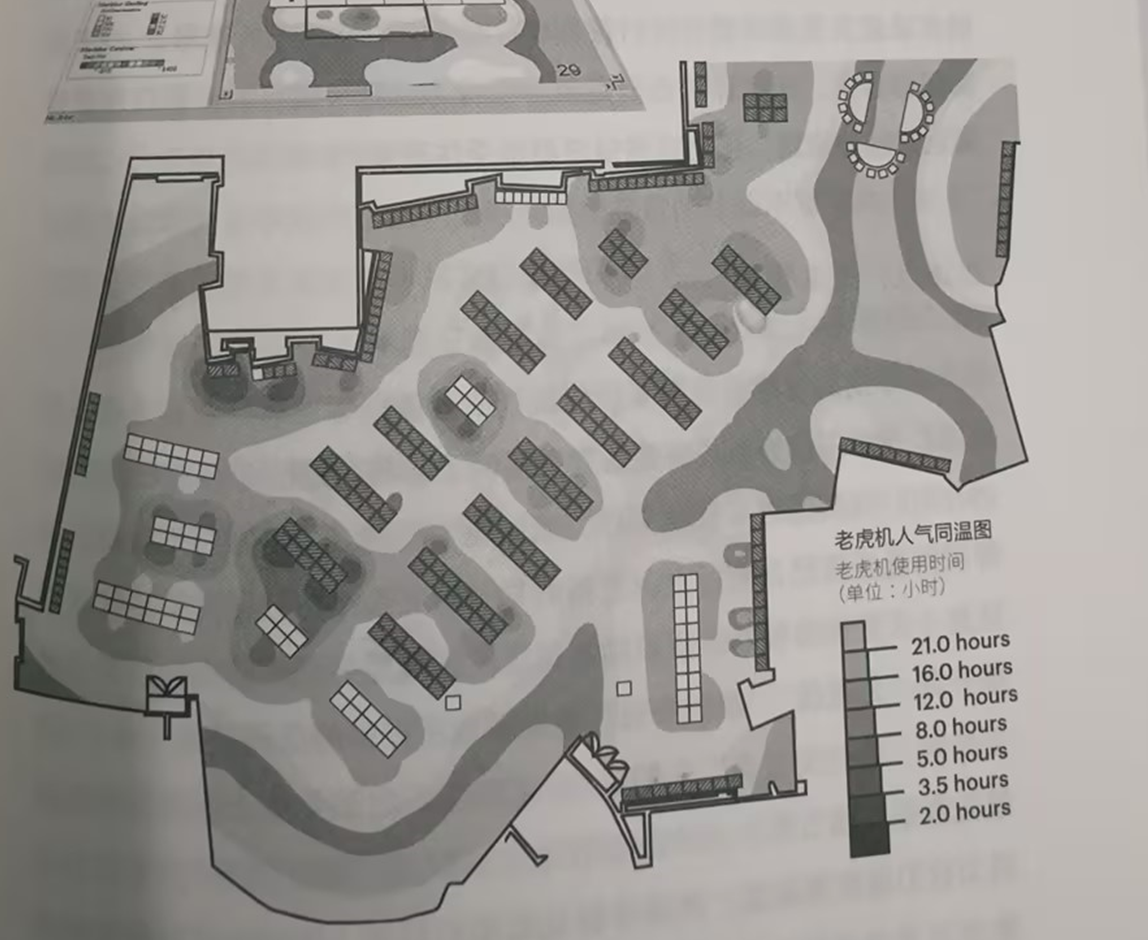
The figure is a heatmap of casino slot-machine use. Regularly arranged machines are used less, while scattered machines in corners attract more activity. This supports the observation that players may prefer to endure their greatest losses quietly in a safe corner.
3. Controlled probabilities
The original discusses Nevada slot machines as not disclosing probabilities: to players they are black boxes, and the allure of that opacity attracts them.
Why do people willingly visit casinos when they know sustained gambling ultimately loses money?
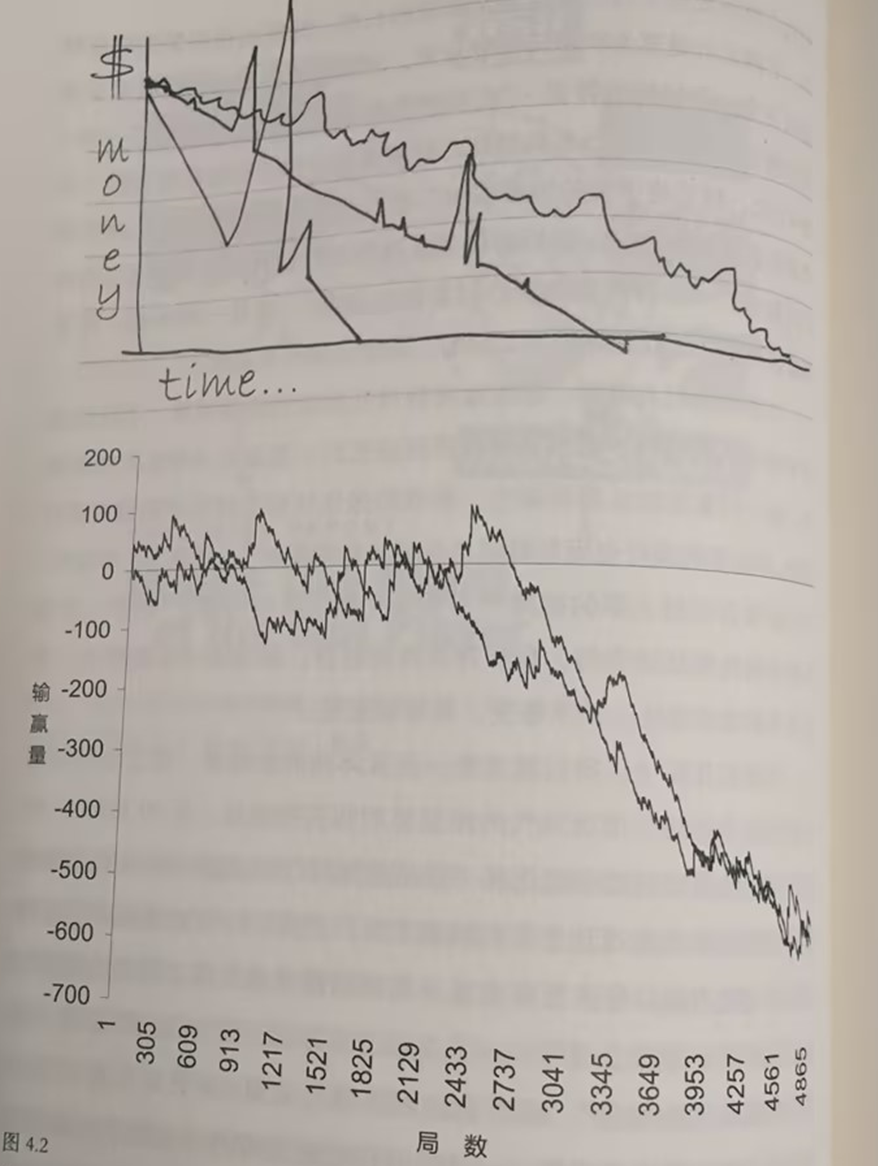
The two curves were drawn by a gambling designer in the book from payout probabilities and trends in the late 1980s and 1990s. Broadly, earlier players preferred lottery-like models with large swings. Over time, smoother fluctuations became more appealing and consumed wealth more slowly.
Players may understand that their money will eventually run out, yet memorable peaks and endings, addiction mechanisms, and the masking of failure keep attracting them.
These three characteristics readily bring to mind the published probabilities of gacha games. I will not expand on that here. As noted earlier, multiplayer competitive designers can compare Texas hold'em's rules, while single-player reward probabilities can be considered alongside pachinko's kakuhen and jitan.
4. Freely controlled risk creates a real feeling of freedom
This is the article's central design insight: continually consider how players can choose their own risks. That accommodates more kinds of people and gives the same person more options. It is a foundational shift in thinking that belongs at the beginning of rule design.
In a Tarkov-like game, do you enter with minimal equipment or a full loadout? After scavenging, do you extract or squeeze in a little more?
In The Binding of Isaac, do you restore health or increase attack power?
In Dave the Diver, with oxygen running low, do you descend further or surface and return next time?
In Armored Core VI, do you earn money through easier missions and upgrade the mech, or rely on skill to overcome the next stage?
In The Finals' Bank It mode, do you collect 10,000 before depositing, or secure the 3,000 you already have?
These designs all use some degree of free risk management, granting different amounts of control according to genre. This article is already getting long enough to affect readability, so I will stop expanding the list. The next two sections use the four risk-design methods to analyze one game and adapt another.
6. A risk-design case study
Dave the Diver
Although it won no award at this year's TGA, Dave the Diver is my personal independent game of 2023. Its idea and story are not exceptionally outstanding, but its design logic is solid and its coupling of systems and mechanics deserves study. It does not feel like the work of an inaccessible genius; its rules and combinations are textbook examples that many designers can learn from.
Risk-design analysis
1. Three-loop design
Diving, running the sushi restaurant, fish farming, agriculture, and other loops are coupled together. In the three-loop framework, this considerably expands minute-to-minute design horizontally.
Second to Second
During diving, depth and oxygen directly connect to risk. Fish type, aggression, size, and movement also shape carefully designed moment-to-moment capture mechanics. Harpoons, guns, and nets serve different circumstances and species.
Minute to Minute
Before diving, players can bring stored items and equipment, encouraging strategic thinking about objectives and anticipated risk. A casual player can simply descend, catch whatever appears, and surface when necessary. A mission-focused player may prepare thoroughly to finish an objective in one trip.
Session to Session
Between chapters, substantial narrative sequences and frequent minigames accompany a carefully prepared opening-up of the larger gameplay systems. The design fits the theme and story closely.
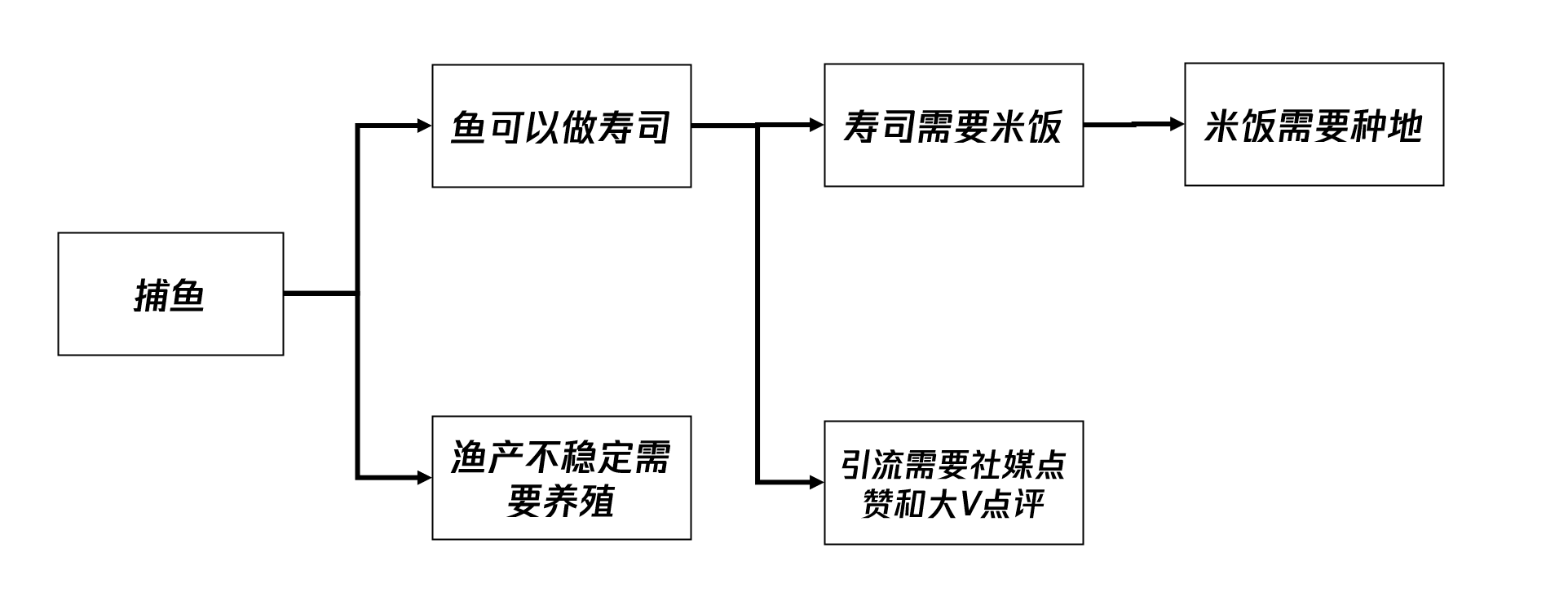
Catch fish; use fish for sushi; the restaurant needs rice; farming supplies rice; uncertain catches encourage fish farming; the restaurant needs customers, leading to social-media likes and influencer reviews.
Although many systems and minigames appear stitched together, they are coherent within the narrative. Their resource exchanges also make sense from the perspective of gameplay outputs, avoiding a jarring impression.
A limitation is that, as a narrative-driven single-player game, many systems are explored only lightly, with constrained resource distribution, exchanges, and loops. Risk here would primarily involve resource management, but the game largely chooses not to challenge players across these systems, leaving little risk in this area.
2. Dividing play into boundaries
Dave offers many examples, but I will focus on oxygen tanks.
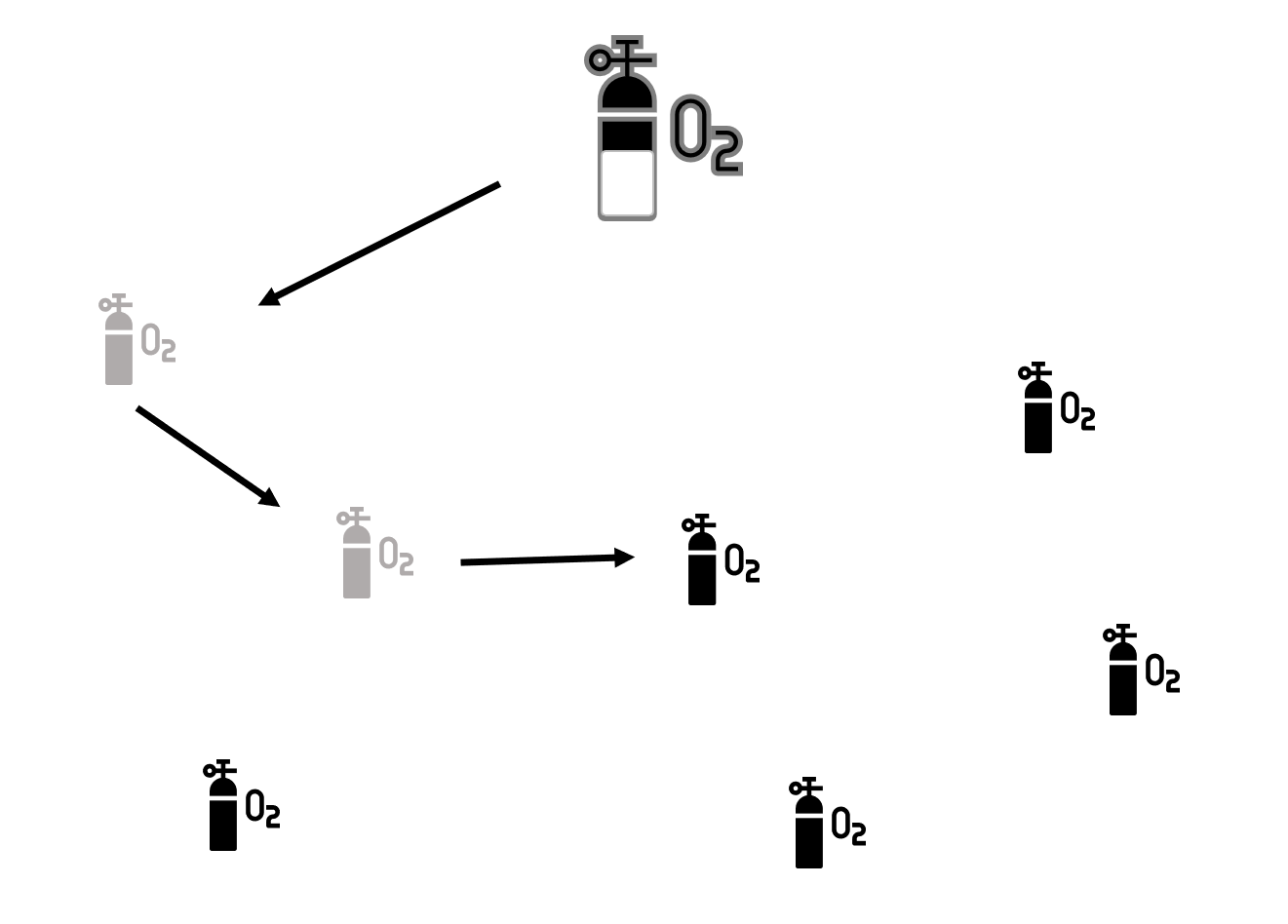
This is an excellent design. Although carrying capacity can be upgraded, finding replenishment tanks is vital for sustained underwater fishing. Each tank resembles a small save point or bonfire: risk accumulates after leaving it. Remembering their locations keeps travel and diving risk within a manageable range. Running low without remembering the previous tank creates a crucial decision. Continuing might reveal another tank and save the dive—or waste all the effort and lose the backpack's contents.

3. Probability design
As a single-player narrative game, Dave uses relatively few probability-based techniques, although fish quality, capture methods, and random spawn locations qualify. A smaller example is hiring restaurant staff.
Each employee has distinctive attributes. High-stat workers cost more, but their growth and abilities can be valuable. Hiring and training a couple of ordinary workers also works, less efficiently. Employees can also be dismissed while seeking the ones you want.
This is largely a resource-allocation preference because the game's currency is shared across systems. Staff improve restaurant automation and revenue, making them an investment. How players invest reveals which systems they favor. Hiring contains some chance and luck, but is more strongly a choice of gameplay preference.

4. Free risk management
The clearest example is that players completely control when to surface during a dive.
Talking to other players, I found different approaches. Some enjoy diving with minimal equipment and using skilled execution to overcome numerical disadvantages. Others maximize equipment and finish comfortably. Others are cautious and surface as soon as conditions deteriorate. Being able to leave a run at any moment is central to free risk management. Weight, oxygen, changing maps, and fish that vary with seasons and time of day make the experience feel very free.
Most importantly, this control feels natural rather than forced. It resembles actual fishing: forecasts and approximate fish locations exist, but each catch remains uncertain and going to sea carries risks. Coherence between mechanics, theme, and narrative creates the underlying enjoyment of play without feeling artificial.
Here is my completion screenshot, in celebration of my personal independent game of the year.
7. An example of adapting a design
Theory loses much of its value without a practical example. I will quickly adapt a classic game to see whether these ideas could make it more enjoyable. This is only a thought experiment: principles that sound valid may fail when implemented in a demo or product. It is intended to broaden thinking, and some applications are admittedly forced, so please do not pick them apart too literally.
Game prototype: Flappy Bird
Design goal: a Flappy Bird capable of long-term service, with stronger engagement and peak–end experiences. It sounds like an unreasonable request from a boss, doesn't it?
1. Three-loop design
Second to Second
Keep the basic controls, reduce initial difficulty, and place collectible small and large feathers along the route at regular intervals. An ordinary bird can carry ten units: a small feather counts as one, a large feather as three.
Minute to Minute
At the start, choose birds emphasizing speed (forward movement), size (collision volume), or strength (feather capacity), each suited to different levels. Items allow players to switch during play.
Accumulation phase
Besides avoiding obstacles, the main goal is collecting feathers. An exit appears after every three obstacles. Players may drop out there and secure their collected feathers, or continue until reaching capacity.
If a bird dies after hitting an obstacle, it cannot be used again that day without switching birds or using a revival coin.
Climax phase
Hidden items resembling Wonder Flowers immediately transform the level: gravity reverses, and small-feather collection doubles.
Settlement phase
After about a minute, a final exit ends the level. A chest there randomly contains feathers, items, and birds. Exiting completes the level, unlocks the next, and awards all feathers collected in that run.
Session to Session
Ten levels form a chapter, and the number of large feathers collected determines chapter unlocks. Level selection follows a nonlinear topology that players choose according to preference. Each level contains exactly three large feathers in different positions, some easier to reach with particular birds.
2. Designing boundaries between play segments
1. A dead bird cannot revive within the normal run and loses all feathers collected in that level.
2. Birds are obtained with small feathers: ten feathers purchase one randomized draw, with rarity corresponding to capability differences.
3. Small feathers are the base currency and buy consumable items to bring into important levels, such as revival coins, instant repositioning, or teleporting to collect feathers.
4. Each chapter ends with a final level that can be attempted only three times daily. After three failures, players return to earlier levels to collect feathers or discover hidden elements.
Thinking about the boundaries
These choices place accumulation and exploration in ordinary levels. The key peak–end challenge uses a particular SSR bird and prepared consumables, with repeated attempts leading to completion.
3. Probability elements
1. Drawing a bird after accumulating small feathers.
2. Opening chests after repeatedly challenging individual levels.
3. Opening a major chest after a substantial investment in a chapter's boss level.
4. Designing freely controlled risk
Committing birds of different qualities to different bosses is active experimentation. Since accumulated feathers are limited, completing levels with the fewest resources becomes an important skill in managing risk and loss.
These are rough illustrations of the four methods applied to an imaginary design, intended only to test and use the framework.
Final chapter: conclusion
Without noticing, I have written more than 13,000 Chinese characters—clearly a talkative game designer. If you would rather skip the seven chapters of reasoning and go directly to the conclusion, it is one sentence: player freedom can be increased through more deliberate design of the risks players face.
Discussion is welcome.
References
The Art of Failure — Jesper Juul, Denmark.
Addiction by Design — Natasha Dow Schüll, United States.
GDC 2004 talk: Risk and Return — Masahiro Sakurai.